The 2026 SFSU Biodesign Challenge, and Pando Awards Finalist Teams Have Been Selected!!!
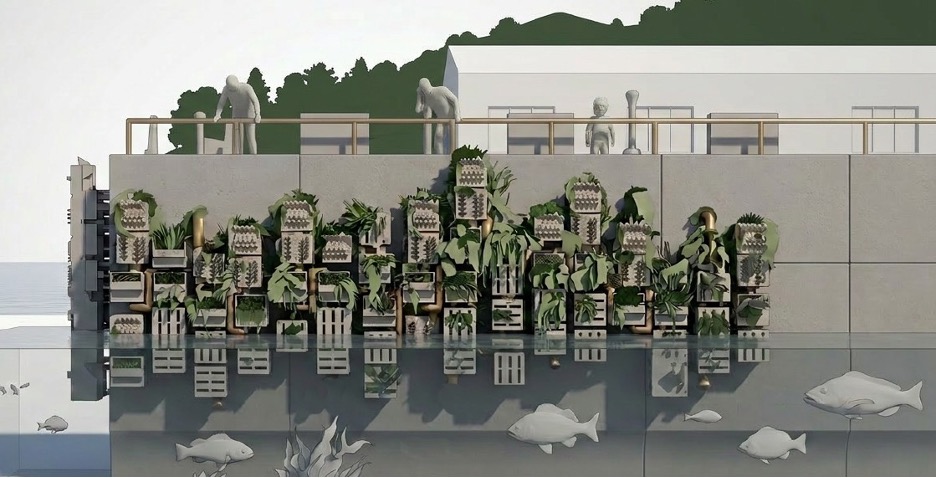
Coastal Resonance living seawall installation – modular blocks with varying textures and shapes arranged at different heights on a metal piping structure that reverberates ocean sounds to researchers and visitors at the deck. Project and images by April Anderson, Jason Lee, and Dominic Taylor.
On May 19th, a panel of five jurors assessed the projects proposed by the five teams of students in the Spring 2026 DES.410 Product Design class, led by Associate Professor Fernando Carvalho, and supported by designer, author and marine ecology advocate Josie Iselin. The jurors provided feedback to each of the teams, based on their assessment of the scientific and creative merits of their projects. Coastal Resonance, by April Anderson, Jasion Lee, and Dominic Taylor, got selected to compete in the Biodesign Challenge; while Adaptive Living Seawall, by Vivack Chan, Katalina Ruiz, and Athena Valli, was chosen to participate in the Pando Awards.
The Estuarine and Ocean Science Center (EOS) is the only marine lab concerned primarily with the health and understanding of San Francsico Bay ecologies. EOS’s physical edge is Richardson Bay, located just North of Golden Gate Bridge, and this shoreline is of utmost importance as key infrastructure for the future of this marine lab. This liminal space offers designers and the Biodesign Challenge students a unique opportunity to think about the broad issues of building resilience around sea level rise and biodiversity loss, as an example of hyper-local application of living seawall concepts specifically designed for/at the EOS Center.
The 2026 Biodesign Challenge class of SFSU students worked collaboratively with EOS Center faculty and staff to research materials, design and applications of living seawalls and to propose EOS-focused solutions that might range from the wildly hypothetical to the extremely practical. Research, fieldwork, and project assessment were facilitated by a partnership with EOS’s Director, Prof. Kathy Boyer, and grad students Amy Yoger and Jivan Khakee. This collaboration between scientists and designers promoted a unique opportunity to enrich students’ experiences, and to advance the field of biodesign within the SFSU university environment.
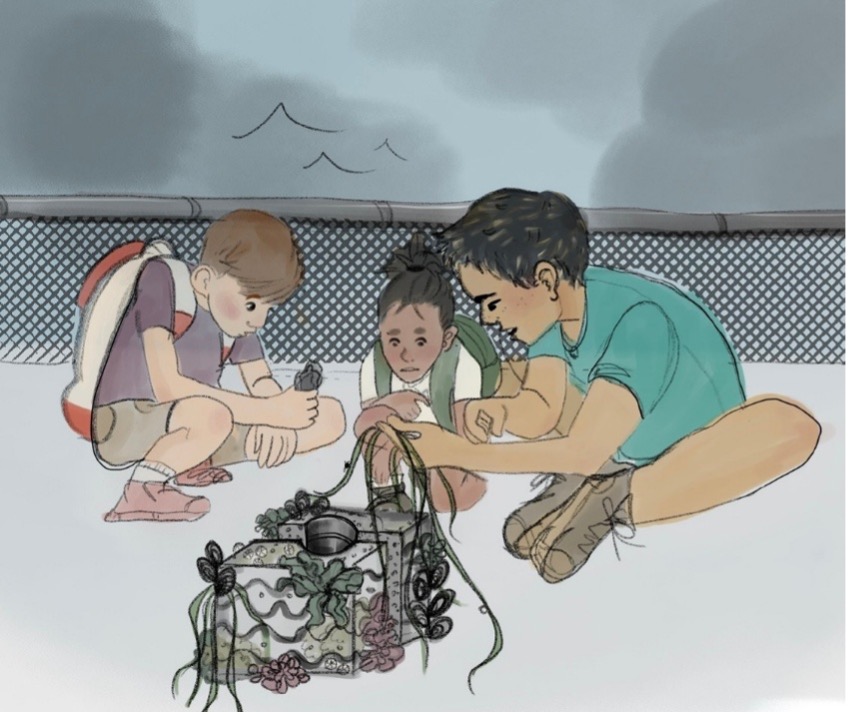
Some of the blocks are removable and invite visitors to take a closer look at the organisms inhabiting the living seawall; this provision fosters education and engagement, particularly from children and youth, encouraging environmental awareness and action. Project and images by April Anderson, Jason Lee, and Dominic Taylor.
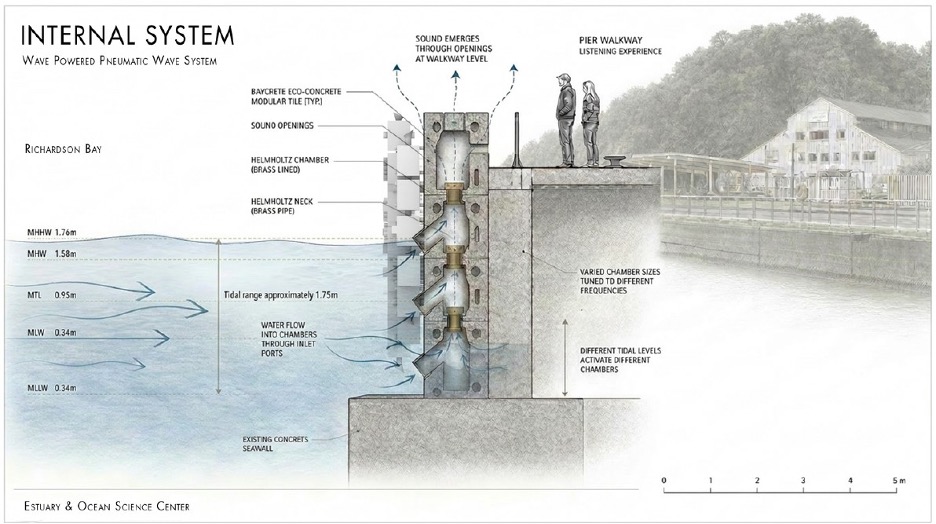
The living seawall biocrete blocks are attached to a structure of pipes that resonates sounds from the ocean up to the deck, according to changes in tides and the movement of water. Project and images by April Anderson, Jason Lee, and Dominic Taylor.
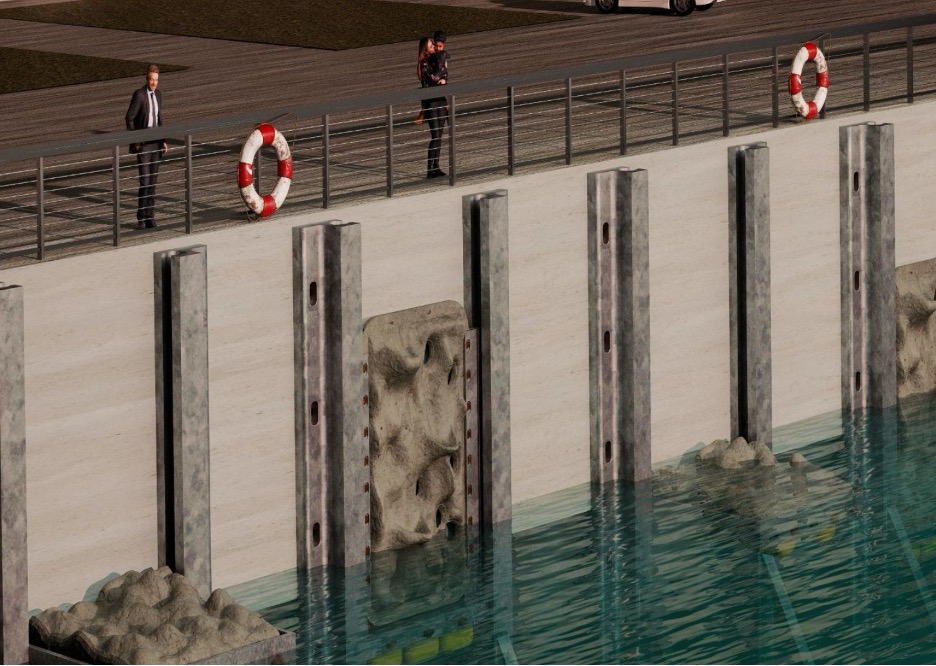
Adaptive Living Seawall constitutes vertical and horizontal biocrete platforms held at different water levels by buoys and a wall-mounted system of tracks. Project and images by Vivack Chan, Katalina Ruiz, and Athena Valli.
The design teams and projects in the Spring 2026 DES.410-01 class are:
Coastal Resonance, SFSU Biodesign Challenge Selected Finalist
April Anderson, Jason Lee, Dominic Taylor
Adaptive Living Seawall, SFSU PANDO Awards Selected Finalist
Vivack Chan, Katalina Ruiz, Athena Valli
Ecological Seawall
Andrea de Jesus, Natalie Nunez, Stepan Valyeyev
Seawall of Hexapods
Luis Blas, Alexander Chadwick, Marisol Gonzalez
Living Coastal Infrastructure
Julian Marquez, Alicianna Roman, Sarthak Thakur
We would like to acknowledge the financial support provided by the Climate HQ Faculty Mini Grant, and Mr. Richard Ingalls’ donation (for the second consecutive year). The funds provided by these institutions and individuals allowed registration in the Biodesign Challenge event, support to invited jurors, support to prototype building, and travel arrangements. These facilities are critical as they help facilitate exceptional learning opportunities to our class cohort, including participation of the selected teams in the 2026 Biodesign Challenge competition this coming summer, and in the PANDO Awards next Fall.
The Spring 2026 class and the School of Design would also like to extend a warmhearted thanks to the jury panel for their time, enthusiasm, support and expert feedback.
JURY PANEL
Amy Yoger
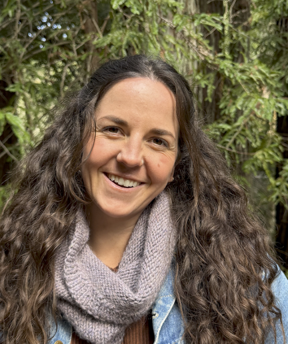
Amy Yoger is a coastal ecologist and recent M.S. graduate in Interdisciplinary Marine and Estuarine Sciences from San Francisco State University, where she conducted research at the Estuary & Ocean Science Center in Dr. Kathy Boyer’s Lab. Her work focuses on understanding how climate change stressors affect eelgrass ecosystems and species interactions in the San Francisco Estuary, with the goal of supporting baylands restoration and conservation efforts. Amy has contributed to a wide range of coastal and wetland projects in California, including eelgrass restoration, living shoreline monitoring, habitat mapping, biodiversity surveys, and environmental field research. Before graduate school, she worked across environmental education, nonprofit leadership, and marine science roles that strengthened her commitment to connecting science with community impact. She is passionate about multi-disciplinary collaboration and using science, education, and art to support resilient coastal ecosystems and communities.
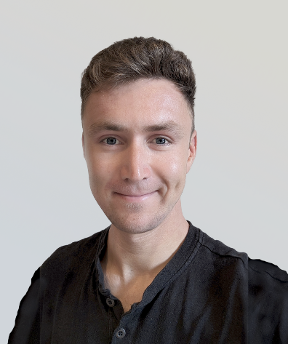
Ben Corwin is a Mechanical Engineer and Product Designer with expertise in the design, analysis, and execution of innovative physical products. He holds an MA in Product Design from San Francisco State University and a BS in Mechanical Engineering from Carnegie Mellon University, providing a balanced skill set covering aesthetics, human factors, and technical feasibility. Professional history includes experience as a Mechanical Design Engineer, during which he designed and prototyped complex mechanical systems, ranging from the development of a 3-axis mechanical assembly for automated palletization to the rigorous execution of Federal Aviation Administration (FAA) certification testing for lightweight composite air cargo pallets. Prior academic engagements include instruction of Industrial Design, with a particular emphasis on manufacturing methods, material selection criteria, and essential engineering principles for design students.
Josie Iselin
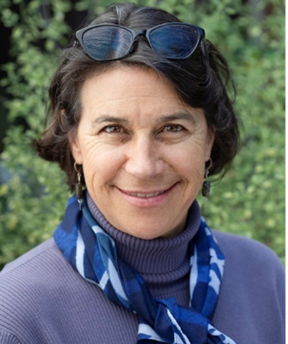
Josie Iselin is an artist, author, and book designer who has been telling seaweed and kelp stories for over a decade. Her two books An Ocean Garden: The Secret Life of Seaweed (2014, reprint 2023 OSU Press) and The Curious World of Seaweed (Heyday, 2019), tap her profound understanding of seaweed’s natural history and her deep connections within the seaweed science community. Both books have won the Tiffany Award for algal communications by the Phycological Society of America. Josie is co-director of the Above/Below campaign whose mission is to make the kelp forests of the oceans as understood as the forests on land. She is the lead author and content director of the campaign’s webstory, The Mysterious World of Bull Kelp, published in November 2023. Above/Below is embarking on the storytelling journey around the native West Coast Olympia oyster. She teaches in the School of Design at San Francisco State University, inspiring the integration of art and storytelling through portfolio design. Her work is on view at josieiselin.com.
Silvan Linn

Associate Professor Silvan Linn received a B.I.D. from Carleton University in Ottawa, Canada working on the design of smart assistive medical devices, and later an M.S.D. from Arizona State University studying slow technology and new theories of human-machine interfaces. His research interests include advanced rapid prototyping techniques, local-scale manufacturing, and product development, new human-machine interface concepts, smart products, and embedded technologies. Prof Linn’s interests and expertise focus on advanced prototyping techniques, small-scale/DIY manufacturing and product development, novel human-machine interface concepts.
Fernando Carvalho
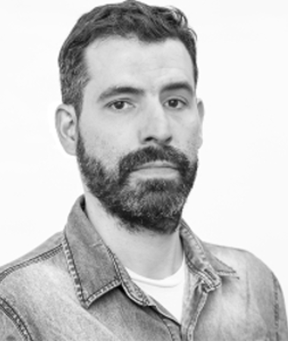
Fernando Carvalho is Associate Professor in the School of Design at San Francisco State University. His design research and practice are primarily focused on healthcare service, products and systems, integrating participatory design and behavior change in the creation and improvement of healthcare service provision. Fernando earned a Ph.D. in Design from Loughborough University (UK), and an MFA in Industrial Design from the University of Notre Dame (USA). He holds BFA degrees in Visual Communication, and Product Design from the Catholic University of Rio de Janeiro (Brazil). For the past four years, Dr. Carvalho has secured multiple internal and external grants and private donations to support the participation of design students from SFSU in the Biodesign Challenge.
Related News